

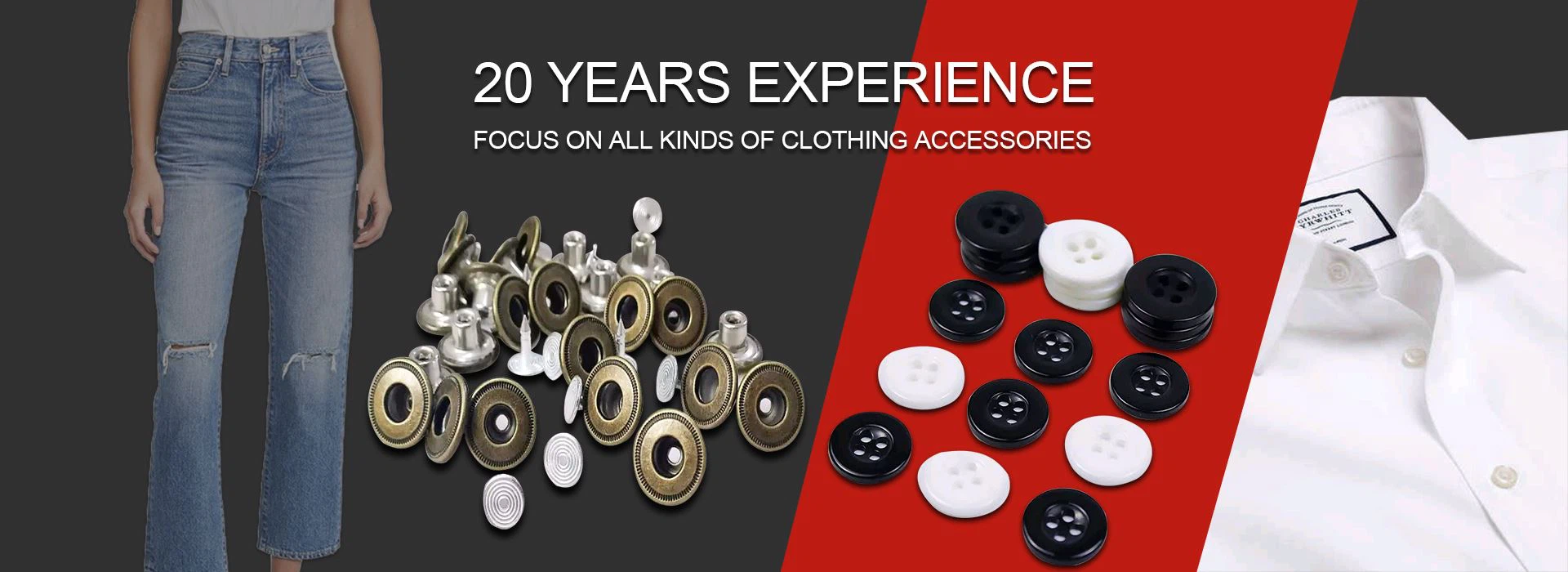
How to Choose the Right Button for Different Fabric and Garment Types
Apr 30, 2026
In garment manufacturing, buttons are often treated as a "small accessory decision" during product development. In practice, they are not small at all.
A wrong button choice can lead to sewing problems on production lines, visible quality issues in retail stores, or durability failures after washing and daily wear. Many garment factories only fully realize this after scaling from sampling to bulk production, when consistency suddenly becomes more important than design intention alone.
At Wuxi Xinchao Garment Accessories Co., Ltd., we often see the same pattern: a button that looks perfect in a sample room may behave very differently once it enters real production conditions, especially when thousands or even millions of garments are being processed.
Choosing the right button is therefore not just about style matching. It is about aligning material strength, thickness, structure, and installation behavior with the fabric and garment type in real manufacturing environments.
For lightweight fabrics such as chiffon, cotton voile, or thin polyester blends, buttons need to be selected carefully because the fabric itself cannot support excessive weight or installation stress. In these cases, smaller and lighter buttons are usually preferred. Plastic resin buttons are commonly used because they provide enough functional strength while keeping weight low and avoiding unnecessary strain on delicate fabrics. If a heavy metal button is used on very light fabric, the garment may start to sag or lose its intended drape after repeated use.
Inside production workshops, we often observe that lightweight garments are more sensitive to button weight than expected. Even small changes in button thickness or diameter can affect how the garment hangs when displayed or worn.
For medium-weight fabrics such as standard cotton, denim shirts, work shirts, and casual wear, the selection becomes more flexible. Both plastic and metal buttons can be used depending on design requirements. Cotton fabrics generally provide stable sewing support, which allows for a wider range of button styles including four-hole buttons, two-hole buttons, and decorative designs.
Denim garments, however, introduce a different set of requirements. Because denim is thicker and more structured, buttons must withstand higher pulling force during wear. Metal buttons are commonly used here, especially rivet-style or tack buttons, because they provide stronger mechanical anchoring. In denim production, button failure is not just a cosmetic issue-it can directly affect garment usability and customer satisfaction.
We once worked with a denim manufacturer who initially used lightweight alloy buttons to reduce cost. During wear testing, several buttons detached after repeated stretching and washing cycles. After switching to reinforced metal buttons with stronger attachment structures, the failure rate dropped significantly. That experience reinforced a common reality in garment production: material compatibility matters more than initial cost optimization.
For heavy fabrics such as coats, jackets, uniforms, and industrial workwear, button selection becomes even more critical. These garments are exposed to repeated stress during wearing, fastening, washing, and sometimes even outdoor working environments. Buttons used in these applications must not only be strong, but also stable under temperature changes and repeated mechanical force.
Metal buttons, particularly brass or stainless steel types, are commonly used because they offer higher structural reliability. Shank buttons are also frequently chosen because they distribute stress more evenly and reduce direct pulling pressure on the fabric surface. In industrial workwear, button failure can interrupt functionality, so durability is usually prioritized over decorative appearance.
At Wuxi Xinchao Garment Accessories Co., Ltd., customers producing outdoor jackets and uniforms often focus heavily on long-term durability testing rather than visual design alone, because garments may be exposed to harsh working conditions over extended periods.
For knitted fabrics such as sweaters and stretch garments, the challenge is different again. Knitted materials are flexible and elastic, which means they can deform easily if the button or attachment method is too rigid. In these cases, buttons with smoother edges and moderate weight are preferred to avoid damaging the yarn structure.
Shank buttons are often used because they reduce direct stress concentration on the fabric surface. If standard flat buttons are used without proper reinforcement, knitted garments may experience stretching around the button area over time, especially after repeated wearing and washing.
Children's clothing introduces another layer of consideration. Safety becomes just as important as durability and appearance. Buttons must be securely attached, smooth in surface finish, and free from sharp edges. Small detachable components are generally avoided in many safety-conscious designs. Lightweight plastic buttons are commonly used because they reduce injury risk and improve comfort.
For fashion garments, the decision often shifts toward aesthetics and brand identity. Designers may prioritize color, texture, and visual harmony with the fabric rather than maximum strength. Natural materials such as shell or corozo buttons are often selected for premium shirts and designer garments because they provide a more refined and organic appearance. However, even in fashion applications, basic durability requirements still need to be met, especially for garments that go through regular washing and retail handling.
Inside real garment production environments, button selection is rarely based on a single factor. Manufacturers usually balance fabric behavior, garment structure, production efficiency, and end-user expectations at the same time. Even sewing machine compatibility can influence button choice, especially in high-speed automated production lines where consistent thickness and hole alignment improve efficiency.
We have seen cases where small differences in button thickness caused feeding issues during automated sewing, slowing down production lines significantly. Once the button specification was standardized, production efficiency improved immediately. These are the kinds of practical details that are often overlooked during early design stages but become very important during mass production.
At Wuxi Xinchao Garment Accessories Co., Ltd., we generally advise customers to evaluate button selection not only from a design perspective, but also from a production and long-term usage perspective. The most suitable button is rarely the most decorative or the cheapest-it is the one that works reliably with the fabric, performs consistently during manufacturing, and remains stable throughout the garment's real-life usage cycle.
In the end, choosing the right button is not just a design decision. It is a manufacturing decision that directly affects garment quality from the production line to the end user.


